
The Dawn of the Reusable Era: Why Every Rocket Landing is a Giant Leap
SpaceX pushes the absolute boundaries of physics with Starship Flight 12. A global wave of aerospace companies…
SpaceX pushes the absolute boundaries of physics with Starship Flight 12. A global wave of aerospace companies is mastering the incredible art of first-stage recovery. The entire industry is winning.
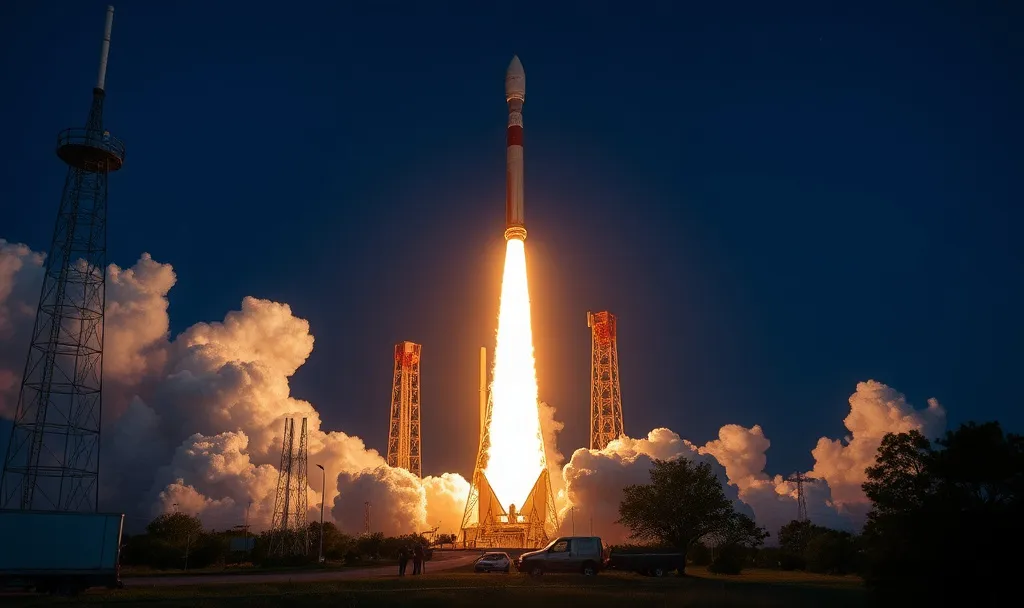
It has been a month since the last post. We have just enjoyed the festive Chinese New Year. And in the Year of the Horse, I wish you all a prosperous and fruitful year ahead! After a long break and refreshment, today I would like to explore deeper with you the outlook of rocketry in 2026.
When Elon Musk recently announced that SpaceX is gearing up for Starship Test Flight 12, a wave of palpable excitement rippled through the aerospace community. The expectations are astronomical, and rightfully so. Test Flight 11 was a watershed moment in human spaceflight: a colossal, 50-metre-tall steel silo plummeted through the atmosphere at near-orbital velocity, endured the searing plasma of reentry, maintained perfect attitude control, and executed a flawless soft splashdown in the ocean.
It is easy to look at the towering achievements of the Starship programme and feel like everything else is in its shadow. But that perspective misses the forest for the trees. Across the globe, multiple aerospace companies are actively testing, launching, and landing their own reusable rockets.
Right now, the global launch market is undergoing a fundamental transformation. Mastering the recovery of a first-stage booster is one of the most difficult engineering challenges humanity has ever tackled. To truly appreciate the golden age of rocketry we are entering in 2026, we need to unpack the sheer brilliance required to catch a falling skyscraper, and then look at the terrifying physics required to bring an orbital stage back from the brink.
Part 1: The Heroic Feat of Landing a First Stage
Landing a first-stage booster—the massive bottom section of a rocket, like Blue Origin’s New Glenn or Landspace’s Zhuque-3—is an absolute marvel of modern engineering. It is a choreographed ballet of control theory, fluid dynamics, and supersonic aerodynamics.
When a first stage detaches from the upper stage, its job of pushing the payload out of the thickest part of the atmosphere is done. But its journey home has just begun.
· The Altitude: Engine cutoff (MECO) typically happens in the thin air around 50 to 70 kilometres above the Earth.
· The Speed: At separation, the rocket is travelling at a blistering 5,000 to 7,000 kph (Mach 5 to Mach 6).
Once separated, the booster must execute a highly complex sequence of manoeuvres to survive:
1. The Boostback Burn: Firing engines in the vacuum of the upper atmosphere, the rocket cancels out its forward momentum and aggressively pivots to aim back towards a landing pad or an ocean droneship.
2. The Supersonic Freefall: As the booster falls back into the thickening atmosphere engines-first, it acts like a giant lawn dart. Titanium grid fins deploy near the top. These act like the feathers on a badminton shuttlecock, aggressively steering the 15-storey vehicle as it plummets through crosswinds.
3. The Landing Burn: In the final, nail-biting seconds, the rocket reignites its engines. This requires precise thrust vectoring (gimbaling the engines to steer) to rapidly bleed off the remaining speed, touching down gently on a target the size of a postage stamp relative to the ocean around it.
But perhaps the most underappreciated miracle of this entire sequence is the physical act of mid-air reignition. Firing up a rocket engine while plummeting backwards through the lower atmosphere is akin to lighting a candle in a typhoon. The vehicle is slamming into a wall of dense, turbulent air, creating chaotic wind shear directly across the open engine bells at the exact moment the system requires a perfectly stable, highly flammable environment to spark combustion.
Compounding this meteorological nightmare is the state of the rocket’s internals: the fuel tanks are practically running on fumes. Because the booster has already expended the vast majority of its propellant pushing the payload towards orbit, the tanks are essentially massive, mostly empty caverns. In the violent, shaking environment of atmospheric freefall, the tiny reserve of remaining liquid propellant aggressively sloshes around. To feed the hyper-fast engine turbopumps, this liquid must be flawlessly and continuously pressurised. Regulating the internal pressure of a nearly empty tank under these extreme dynamic loads is a monumental challenge in fluid mechanics and thermodynamics. If the pressurisation system stutters, or if a pump ingests a single bubble of pressurant gas instead of liquid fuel, the engine will instantly choke and fail.
While the primary external challenge here is aerodynamic stability—as the rocket is flying backwards, engines first, through turbulent air, requiring thousands of sensor inputs per second just to keep from flipping over and tearing itself apart—the internal physics are just as daunting. Achieving this delicate balance of internal pressure and external control is a monumental victory for any aerospace team. It slashes the cost of access to space and turns rockets from disposable ammunition into commercial airliners.
Part 2: The Orbital Stage – Pushing into the Thermal Unknown
If recovering a first stage is mastering the atmosphere, recovering an orbital upper stage—like Starship—is mastering kinetic energy. The difficulty does not just scale up; it enters an entirely new realm of physics.
When the upper stage separates, its job is to push the payload all the way into orbit. To achieve orbit, you cannot just go high; you must go incredibly fast sideways to outrun the Earth’s curvature.
· The Speed: An orbital stage must reach a velocity of over 27,000 kph (Mach 22+).
Here is where the maths becomes daunting. Kinetic energy is governed by the equation . Because velocity is squared, an orbital vehicle travelling four times faster than a first stage possesses sixteen times more kinetic energy per kilogram of mass.
When it is time to return to Earth, a rocket cannot simply carry enough fuel to fire its engines and slow down from 27,000 kph to zero. If it did, it would be too heavy to launch in the first place. Instead, the vehicle must use the Earth’s atmosphere as its brake pads. The heatshield is as much an airbrake.
The Challenges of Orbital Return:
· The Plasma Sheath: At Mach 22, the spacecraft compresses the air in front of it so violently that the shockwave heats the gases to over 1,500°C, turning the air into glowing plasma. The vehicle must be shielded by thousands of intricate thermal protection tiles. It is a true baptism by fire.
· The Belly Flop: Unlike a first stage that falls vertically, Starship must reenter belly-first. It uses its massive surface area to create drag, acting like a colossal skydiver. It steers using four distinct aerodynamic flaps, constantly adjusting to surf the plasma wave without burning up.
· The Transonic Transition: As the ship slows from hypersonic to subsonic speeds, the aerodynamics shift wildly. The centre of pressure moves, and the vehicle has to fight massive instability to maintain its orientation.
· The Flip and Re-ignition: Only seconds before hitting the surface, the vehicle must execute a violent acrobatic flip, transitioning from a horizontal free-fall to vertical, engine-powered flight. Reigniting cryogenic rocket engines while hurtling sideways through unpredictable atmospheric winds is one of the most complex fluid dynamics problems ever solved. Similar to the first stage, the fuel tanks are almost empty and the pressure regulating requires ingenious engineering.
When Flight 11 successfully hovered over the ocean after surviving this ordeal, it proved that bleeding off orbital kinetic energy without destroying the vehicle was not just a theory—it was a reality. Flight 12 will take this even further. Finger crossed.
Part 3: The 2026 Market Outlook – A Thriving Global Ecosystem
The incredible work SpaceX is doing with Starship does not diminish the efforts of the rest of the industry; rather, it highlights how vibrant and rapidly advancing the entire aerospace sector has become. Full, rapid reusability is the ultimate prize, but mastering first-stage reusability is the vital, necessary foundation of the next decade’s space economy. After that, establishing a sound supply chain to ensure smooth and frequent launch operations would determine which launchers can survive the competition.
Here is a look at the incredible strides being made across the globe:
1. The Arrival of Blue Origin
One of the most celebrated milestones recently was Blue Origin successfully landing the massive New Glenn first stage back in November 2025. This was a massive win for the industry. New Glenn is a formidable, beautifully engineered heavy-lift machine, and its successful recovery officially expanded the reusable heavy-lift market. It proves that the “first stage” code has been thoroughly cracked by more than one player, providing satellite operators with robust, competitive launch alternatives.
2. China’s Commercial Sprint: The Innovators
The Chinese commercial space sector is currently in a state of high-stakes, well-funded innovation. They are moving fast and making brilliant engineering choices, such as leveraging Methalox (methane-oxygen) engines, which burn much cleaner than legacy kerosene engines and are ideal for reusability.
· Landspace (Zhuque-3): They recently attempted a first-stage recovery that fell just short of complete success. In aerospace, “just short” is a massive compliment. Getting a booster all the way back to the pad requires the telemetry, navigation, and control software to be nearly perfect. They have the physics dialled in; they are simply refining the final hardware limits. They are incredibly close.
· iSpace (Hyperbola-3): Flush with a massive RMB 5 billion capital injection, iSpace is aggressively accelerating their VTVL (Vertical Takeoff, Vertical Landing) hop tests. In rocketry, data is king. This funding allows them to be hardware-rich, iterating rapidly and pushing their designs to the limit.
· CAS Space (Kinetica-2): CAS Space has boldly announced a test flight for their reusable first stage in 2026. Setting a public timeline shows immense confidence in their simulation data and manufacturing pipeline.
3. CASC: The Heavyweight Stepping Into the Ring
The state-backed behemoth, CASC, experienced a setback with the midair explosion of the Long March 12A during testing. However, it is vital to view this through the lens of modern aerospace development: rockets explode during testing so they do not explode during commercial missions. Shifting from a legacy, expendable-rocket mindset to an iterative, software-driven reusable model is a massive paradigm shift. CASC possesses immense engineering talent and resources. This test provided them with invaluable flight data, and they will undoubtedly iterate and return stronger.
The Bottom Line
We are living in the most exciting era of spaceflight since the Apollo missions.
First-stage reusability is no longer a futuristic dream; it is becoming the industry standard, driven by brilliant teams at Blue Origin, Landspace, iSpace, and others. Every time a booster lands—no matter who’s logo is on the side—it drives down the cost of access to space, enabling new orbital industries, better climate monitoring, and global connectivity.
Meanwhile, SpaceX is standing on that solid foundation of first-stage mastery to reach for the next frontier with Starship Flight 12: orbital return.
The rockets are getting bigger, the maths is getting harder, and the industry is rising to the challenge together. 2026, the Year of the Horse, may as well be the Year of Pegasus. And we are going to see the acceleration of the craft of escape velocity.